


Career Advice
How to Negotiate Benefits in a Job Offer
Ask about negotiable benefits with a focused request, clear priorities, and written confirmation, without assuming every employer can change its policies.
Interview Pilot Editorial Team
3 min read
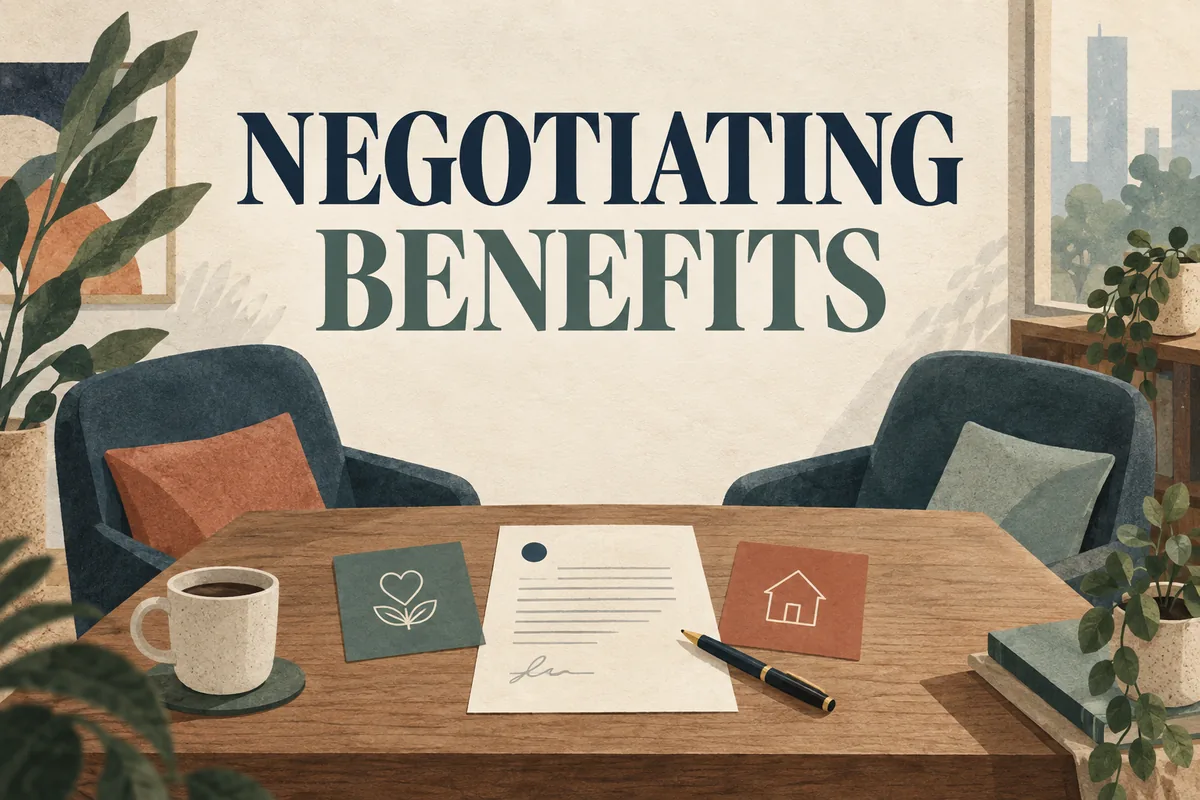
To negotiate benefits, first understand the offer, then choose the one or two changes that matter most to you. Ask whether there is flexibility before assuming the employer can alter a policy for one employee.
Washington University's offer-negotiation guidance notes that some benefits are constrained by organizational policies. This article focuses on how to have the conversation, not on legal entitlements, tax treatment, or the value of a particular insurance plan.
Separate missing information from a request
Before negotiating, ask for the details you need to evaluate the offer: time-off policy, work location expectations, development support, start date, and any conditions attached to proposed benefits.
"How does the development budget work?" is a clarification. "Could the offer include an agreed development budget?" is a request. Combining them can make you appear to be negotiating terms you have not yet understood.
Pick your priorities
Compare the offer with your actual needs. A flexible start date may matter more than a small allowance; a predictable schedule may matter more than occasional remote days.
For each request, write down the preferred outcome, an acceptable alternative, and whether it would affect your decision. Keep that last point private unless you are prepared to stand behind it. Do not invent competing offers or deadlines.
Avoid treating the package as a collection of interchangeable numbers. A one-time reimbursement and a recurring benefit have different conditions and duration.
Make a focused request
Here is an illustrative message to adapt:
Thank you for the offer. I'm enthusiastic about the role and have reviewed the package. Before making my decision, could we discuss two points? An agreed hybrid schedule would help me plan the commute, and I would value support for the role-relevant training we discussed. Is there flexibility on either item, or an existing policy I should review?
This asks for a discussion without implying that the employer has already promised a change. If one point matters much more, say which one you would like to prioritize.
Respond if the policy is fixed
Ask whether a different arrangement is possible, but do not keep repackaging the same request after a clear answer. For example, if a training allowance cannot change, you might ask about access to existing internal training rather than assuming an exception is available.
If the answer is "we can revisit it later," clarify the review date, decision owner, and criteria. A future conversation is not the same as an approved benefit.
Confirm the final terms
Ask for agreed changes in the written offer or the appropriate formal document before relying on them. Check that the wording matches the discussion, including eligibility, timing, approvals, and any conditions. If a material term remains unclear, obtain qualified advice for your circumstances rather than guessing.
For base-pay discussions, see how to negotiate salary after a job offer. Keep the conversations coordinated so the employer can evaluate your complete request rather than receiving a new demand after every agreement.


Topics
Career Advice
how to negotiate benefits in a job offer
Continue reading
Interviews
Interview Questions Librarian: Nine Answers That Impress
Prepare for interview questions librarian candidates face: nine questions, sample answers, and tips on reader services, research, and operations.
November 26, 2026
20 min read
Interviews
How to Answer Tough Interview Questions in 2026
Learn how to answer tough interview questions with clear frameworks, a five-step method, sample answers, and fixes for freezing or rambling.
November 26, 2026
16 min read

Interviews
How to Negotiate Salary in an Interview: Scripts and Timing
Learn when to bring up pay, how to answer salary expectations, and what to say to a low offer, with scripts and U.S. sources you can use in your next interview.
November 26, 2026